AI Sales OS
Most popular
What Is an AI Sales OS? The category that replaces your sales tool stack
Discover why traditional CRMs alone fail modern sales teams.
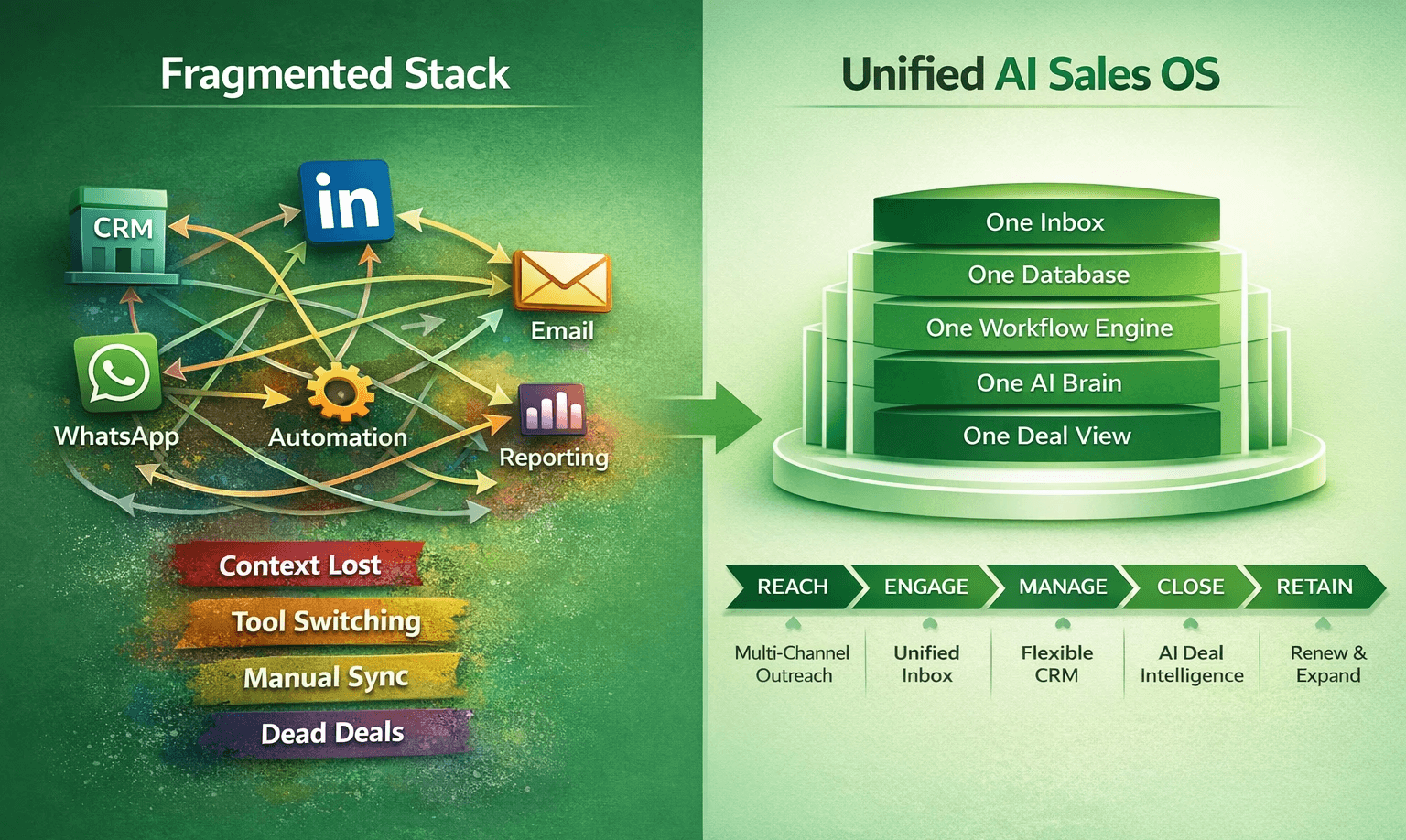
Let me start with a confession. Three years ago, I was a McKinsey consultant helping enterprises buy software. We'd spend weeks selecting a CRM. Then weeks more bolting on email sequences, LinkedIn automation, deal scoring, workflow engines. By month three, nobody knew which tool owned which stage.
The problem wasn't the individual tools. HubSpot is excellent at pipelines. Lemlist nails first-reply rates. Zapier connects everything. But excellent tools don't add up to excellence — they add up to friction, hidden data, and dead deals.
So what's an AI Sales OS?
The Definition: Sales Operating System, Not Scattered Point Tools
An AI Sales OS is a unified software platform that orchestrates the entire sales lifecycle — from first outreach to closed deal to retained relationship — across all channels (email, LinkedIn, WhatsApp, SMS) in a single system, powered by AI that understands your deals, your customers, and what to do next.
Think of it like this: If Attio (the modern CRM) + n8n (workflow automation) + Lemlist (multi-channel sequences) had a baby — powered by AI — you'd have an AI Sales OS.
It's not a CRM. It's not an automation tool. It's the operating system that does both, natively, in one place.
The operating system that actually works.
Why Your Current Stack Is Costing You $32,040 Per Year (And Bleeding Data)
Let's do the math. Most sales teams are running something like this:
Tool | Purpose | Cost/User/Month |
|---|---|---|
HubSpot Professional | Pipeline + reporting | $90 |
Lemlist | Multi-channel sequences | $128 |
Surfe | LinkedIn CRM sync | $29 |
Zapier | Tool integration | $20 |
Total per user | $267/month |
For a 10-person sales team, that's $32,040 per year. Before your conversation intelligence tool. Before Slack integrations. Before your email deliverability tool. Before your credits for lead enrichment.
But the real cost isn't the money.
The real cost is that your prospect's journey is fragmented.
Your outreach team (using Lemlist) sends a sequence. The deal moves to your CRM (HubSpot) when someone replies. But the automation context is lost. The email intent that made them open it? Gone. The follow-up pattern that was working? Disconnected.
A rep opens HubSpot, sees a deal called "Acme - Proposal sent," but no context on whether the last outreach was sent via LinkedIn or email. No reminder of the cadence. No next-best-action button. They wing it. The deal stalls.
This is what happens when your sales operating system isn't actually a system — it's a disconnected stack of tools, each holding a piece of the customer truth.
An AI Sales OS solves this by making the entire lifecycle native to one platform.
The AI Sales OS lifecycle: REACH → ENGAGE → MANAGE → CLOSE → RETAIN
Here's what a true sales operating system actually does.
Stage 1: REACH — Multi-channel outreach without channel sprawl
REACH is how your team gets in front of prospects at scale, across any channel that works.
In a traditional stack:
LinkedIn outreach: Lemlist (or Dripify)
Email sequences: HubSpot or Lemlist or Attio
WhatsApp: Separate tool
SMS: Another integration
Data sync: Zapier, manual work, or lost
In an AI Sales OS like Dalil AI:
Multi-channel sequences: Native LinkedIn, WhatsApp, email, SMS
Single list of prospects: One database, not scattered across three platforms
Zero-copy sync: Send a WhatsApp on Monday, email on Wednesday, LinkedIn on Friday — all from one campaign
AI cadence coaching: The system suggests what channel to try next, based on what's working in your vertical
Why this matters: You're not fragmented. You reach more prospects, faster, and don't lose where you sent what.
Stage 2: ENGAGE — Unified inbox, all Channels, one thread
ENGAGE is the moment a prospect replies. This is where most sales stacks completely fall apart.
Your Lemlist campaign gets a reply → it lands in Gmail. Your HubSpot email gets a reply → it lands in your CRM inbox. Your LinkedIn message gets a reply → it lands in LinkedIn. Your WhatsApp sequence gets a reply → it lands in WhatsApp.
Four inboxes. One prospect. One lost sale.
An AI Sales OS solves this with a Unified Inbox, all replies from all channels, threaded together, in one place.
Every message (whether it came in via LinkedIn, WhatsApp, email, or SMS) appears as a single conversation thread. You see:
The sequence that triggered the conversation
The channel it came through
The sentiment of their reply (engagement scoring)
Suggested next steps (AI)
No context loss. No tool-switching. The conversation stays whole.
Stage 3: MANAGE — Flexible CRM that adapts to how you actually sell
This is where most CRMs get rigid and your team gets frustrated.
Traditional CRMs lock you into a pipeline view:
You get "Lead → Opportunity → Negotiation → Closed Won"
But what if your sales process is actually: Prospect → Demo → Proposal → Negotiation → Sponsor Alignment → Closed Won?
So you either shoehorn your process into their pipeline, or you move to Airtable and abandon your CRM.
An AI Sales OS gives you a flexible CRM:
Custom entities: Define Accounts, Contacts, Opportunities, or Deals, Stakeholders, Decision-Makers, whatever you call them
Custom fields: Add fields without limitations
Custom relationships: One Deal can have many Stakeholders. One Account can have many Deals across multiple channels
Multiple pipelines: Run a sales pipeline, a customer success pipeline, even a partnership pipeline — all in the same system
Your CRM shape-shifts to match your process. You don't twist your process to fit the software.
Stage 4: CLOSE — AI deal Intelligence that actually suggests what happens next
Here's where an AI Sales OS earns its name.
CLOSE is about understanding your deals deeply enough to move them forward.
In a basic CRM, you have:
Deal size
Expected close date
Stage (usually a guess)
You don't know:
Is this deal actually healthy?
What's the real blocker?
Which deal should I focus on today?
What's the next conversation this prospect needs to have?
An AI Sales OS brings AI deal intelligence, the system learns from your deals, your emails, your conversations, and your closed-won patterns. It then tells you:
Deal health scoring: Based on email sentiment, response cadence, and likelihood-to-close patterns
Risk signals: Early warning when a deal is going cold (no reply in 7 days when your average is 3 days)
Next-best-action: Not just "follow up" — specific: "Send a low-pressure WhatsApp asking about their timeline"
Win probability: What's the real chance this closes, based on what similar deals did
This isn't magic. It's pattern recognition. But it means your team isn't guessing.
Stage 5: RETAIN — Same platform, post-sale
Most sales stacks stop at "Closed Won."
An AI Sales OS doesn't.
The same platform that won the deal handles the upsell, the renewal, the expansion. Your CSM can:
See the original sales conversation (full context on why they bought)
Log ongoing engagement (interactions, sentiment, health)
Know when to expand (AI identifies expansion signals)
Move deals through a renewal pipeline (same flexible CRM)
No platform switch. No context loss. No "we won the deal but we don't know why."
The Coverage Map: Who Does What, Across the Lifecycle
This is the clearest way to see why an AI Sales OS is different:
REACH ENGAGE MANAGE CLOSE RETAIN
Dalil AI ████████ ████████ ████████ ████████ ████████
Breakcold ░░░░░░░░ ████████ █████░░░ ████████ ░░░░░░░░
HubSpot ██████░░ █████░░░ ████████ ████░░░░ ████████
Lemlist ████████ ████████ ░░░░░░░░ ░░░░░░░░ ░░░░░░░░
Pipedrive ░░░░░░░░ ░░░░██░░ ████████ ████████ ░░░░░░░░
Breakcold is strong for social selling, especially around REACH and ENGAGE, and works well for teams that want relationship-driven outreach. It is less focused on being a complete CRM and end-to-end deal intelligence platform.
HubSpot is one of the strongest platforms for CRM, pipeline management, and broader commercial operations. For teams that want advanced multi-channel outbound and more native AI-driven execution across channels, they often complement it with additional tools.
Lemlist is a leading multi-channel sequencing platform and is particularly strong for outbound execution and campaign management. Its focus is on outreach performance rather than acting as a full CRM or deal management system.
Pipedrive is a very solid sales CRM built for pipeline visibility and deal management, and many teams like it for its simplicity. When companies want stronger outbound and engagement workflows, they usually add other tools around it.
An AI Sales OS covers the entire spectrum. In one platform. With native integration between all stages.
This is why the problem with your current stack isn't the individual tools — it's that none of them are designed to work together. You're gluing point solutions together. An AI Sales OS is designed as a system, from REACH to RETAIN.
How Dalil AI implements the AI Sales OS
We built Dalil AI because this category didn't exist, and sales leaders were drowning in tool complexity.
Here's what you get:
Native Multi-channel sequences (REACH)
LinkedIn, WhatsApp, Email, SMS
Conditional branching based on replies
Unified prospect database
No Zapier. No tool syncing. Native.
Unified inbox (ENGAGE)
Every reply from any channel, in one thread
See the sequence that triggered the conversation
Engagement scoring (AI sentiment analysis)
One-click reply across channels
Flexible CRM (MANAGE)
Custom entities and fields (not locked to Opportunities/Leads)
Multiple pipelines
Relationship mapping
Custom views and automations
AI Deal Intelligence (CLOSE)
Deal health scoring
Win/loss prediction
Risk alerts
Next-best-action recommendations
Post-Sale management (RETAIN)
Use the same platform to build additional pipelines for expansion, upsells, renewals while keeping the same record history across the board
Full conversation history visible to CSMs
Custom renewal/expansion pipelines
The promise: From first outreach to closed deal, no context lost.
We built this because context loss is what kills deals. When your outreach data lives in Lemlist, your deal data lives in HubSpot, and your engagement lives in email, nobody has the full picture. Deals stall. You follow up on hunches instead of patterns. You lose.
Dalil AI keeps the picture whole.
AI Sales OS vs. Traditional CRM: The real differences
Let's be direct: A CRM is not an operating system. A CRM is one layer of a system.
Here's how they differ:
Dimension | Traditional CRM | AI Sales OS |
|---|---|---|
Primary design | Pipeline management | Full sales lifecycle |
Outreach | Built-in email only; no multi-channel | Native multi-channel sequences |
First reply | Requires separate tool | Part of the platform |
Channel integration | Bolted on (Zapier, APIs) | Native |
Deal intelligence | Manual notes, forecasting tool | AI-powered health, risk, predictions |
Context loss | Common (data lives in separate tools) | Zero (all data in one system) |
Post-sale capability | Limited or requires migration | Built in from day one |
Cost | $90-300/user/month, plus integrations | Single platform price (lower total cost) |
Setup time | 4-8 weeks (tool selection + integration) | 1-2 weeks (native workflows, no integration) |
The core difference: A CRM is a database. An AI Sales OS is an operating system for the entire sales function.
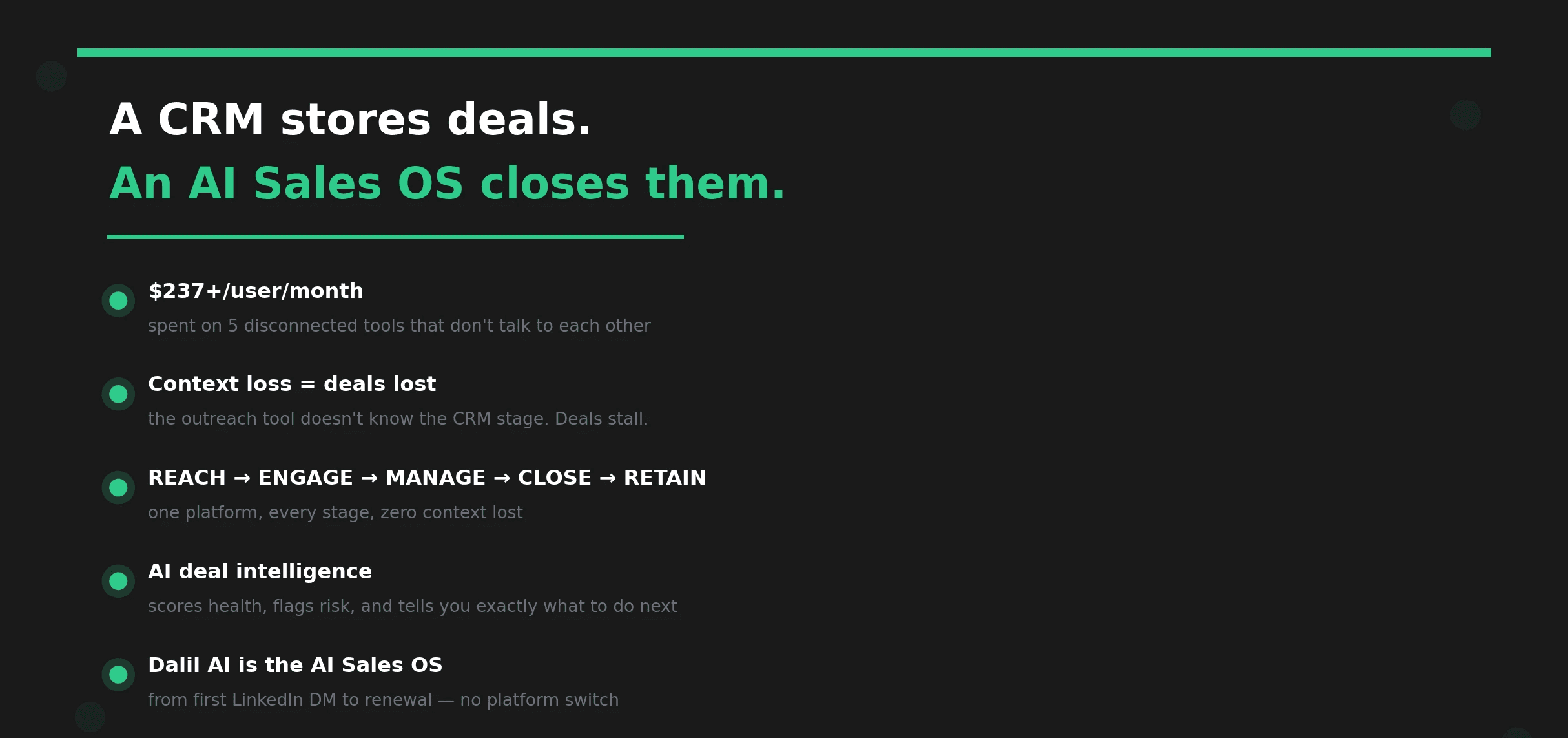
The Real Problem With Scattered Tools: Three Examples
Let me show you what happens in the real world:
Example 1: The lost context problem
Sarah, a sales rep at a SaaS company, runs a campaign in Lemlist to reach VP of Sales at mid-market companies. She sends:
Day 1: LinkedIn message
Day 4: Email
Day 7: LinkedIn message
Day 10: WhatsApp
On day 11, David from Acme replies to her WhatsApp: "Call this afternoon?"
In a scattered stack:
The WhatsApp reply lands in WhatsApp. Sarah sees it.
She logs into HubSpot to create a deal, but the original outreach context is in Lemlist.
She calls David. Great call. But she doesn't mention the pain point from his LinkedIn message (it was in Lemlist, not HubSpot).
After the call, she updates the deal but doesn't log the key insight: "David said their revenue is down 20% — but they're hiring."
Two weeks later, the deal stalls. A junior rep takes over, has no context on the revenue problem or the hiring signal.
The deal dies.
In an AI Sales OS:
The WhatsApp reply lands in the unified inbox.
The system shows the full sequence history and the decision-makers on the deal.
Sarah calls David with full context from the outreach.
She logs the revenue and hiring intel directly on the deal.
The system flags this as a deal health risk (revenue down = procurement delays).
When the deal stalls, the next rep sees the full context and knows why.
One platform. No context loss. Deal advances.
Example 2: The broken workflow problem
James manages a 15-person sales team. His process:
Outreach team sends sequences in Lemlist
When someone replies, a Zapier automation creates a contact in HubSpot
The deal sits in HubSpot until someone qualifies it
If qualified, it moves through the pipeline
If lost, they run a "re-engagement" sequence... in Lemlist again
But re-engagement data doesn't sync back to HubSpot, so nobody knows which lost deals are active again
James spends 30% of his time troubleshooting data sync issues, which deals are "really" active, and why his pipeline forecast is always wrong.
In an AI Sales OS, the workflow is unified:
One outreach/re-engagement system
One deal status system
One forecast (because there's one source of truth)
Zero Zapier. Zero manual data work.
Example 3: The deal intelligence problem
A founder is looking at her pipeline: $2.4M in deals. But she doesn't know which are real.
Deal 1: "Acme — Proposal sent" (3 days ago, no reply)
Deal 2: "Beta Corp — Discovery call" (6 weeks ago, no recent contact)
Deal 3: "Global Inc — Negotiation" (1 week, active email thread)
In a basic CRM, she has three deals that all look the same: sitting in their current stage, waiting.
In an AI Sales OS with deal intelligence:
Acme: Health score 72 (good — responsive so far, one reply delay is normal)
Beta Corp: Health score 18 (critical — should have heard back by now, pattern indicates slowdown)
Global Inc: Health score 91 (excellent — fast replies, good engagement, high win probability)
She knows where to focus. Two of the three deals are at risk. One is hot. She prioritizes accordingly.
The full lifecycle in practice: From first message to renewal
Here's a realistic deal journey through an AI Sales OS:
Week 1 — REACH
Outbound team runs a 3-touch LinkedIn + email sequence to 200 VP of Sales
All contacts land in a unified prospect database
AI suggests optimal timing based on past reply patterns
Week 2 — ENGAGE
David from Acme replies on LinkedIn
His reply appears in the unified inbox alongside the original message
System flags high engagement score (replied on day 3, faster than average)
Week 3 — MANAGE
Sarah's sales rep logs a discovery call with David
Call notes are saved on the deal
System detects a buying signal (mentioned Q2 budget)
Deal is moved to "Opportunity" pipeline
Week 4 — CLOSE
System sends a proposal
Deal intelligence shows health score 85 (trending up)
AI suggests: "Send a low-key WhatsApp in 3 days if no response" (not an aggressive email)
Rep sends the WhatsApp
David replies: "Love it. Getting approval from CFO."
Week 5 — CLOSE (continued)
Deal health score 92
System flags "stakeholder approval pending" as key blocker
AI suggests: "Schedule a 15-min call with CFO for final sign-off"
Rep schedules and wins the deal
Week 8+ — RETAIN
David becomes a customer
Same platform: CSM logs implementation calls
System flags expansion trigger: "Customer trialed Feature X" → customer success flags for upsell
CSM uses same platform to manage renewal pipeline 12 months later
Full context preserved: CSM knows why they bought, what problems they had, what features drove value
One deal. One platform. Context preserved at every stage.
The Bottom Line: Your sales stack is killing seals
You're spending $32,040 per year per 10-person team on tools. You're losing context every time a deal moves between tools. You're following up on hunches instead of patterns. Your team hates the tool fragmentation.
An AI Sales OS solves all of this by doing one thing: putting your entire sales operation — from REACH to RETAIN — in one native, AI-powered platform.
This is the category that replaces scattered point tools.
If you're ready to see what an integrated sales operating system looks like, start your 14-day free trial of Dalil AI. No credit card required. Full access to multi-channel sequences, unified inbox, flexible CRM, and AI deal intelligence.
FAQ: Common questions about AI Sales OS
What's the difference between an AI Sales OS and a sales automation platform?
A sales automation platform (like Zapier) connects existing tools. An AI Sales OS replaces the need for multiple tools.
Sales automation says: "I'll sync your Lemlist data to HubSpot." An AI Sales OS says: "You don't need both — your sequences and deals live together."
Do I need an AI Sales OS if I'm using HubSpot?
HubSpot is excellent for pipeline management. But if you're:
Running outreach sequences in Lemlist (separate tool)
Using Surfe for LinkedIn sync (separate tool)
Managing email in Gmail (separate tool)
Using Zapier to glue them together (separate tool)
Then HubSpot is one layer of a sales stack, not a sales operating system. An AI Sales OS would replace all four of those point tools.
Will an AI Sales OS work for my sales process?
If your process is:
Outreach at scale
Multi-channel engagement
Deal management with custom pipelines
Post-sale relationship management
Then yes. An AI Sales OS is designed for sales processes like this.
If your process is entirely account-based (very high touch, 3-4 deals per rep), you might get more value from a CRM. But most B2B sales teams benefit from an AI Sales OS.
How long does it take to set up?
A traditional CRM takes 4-8 weeks (you have to build integrations, migrate data, map your process to their rigid pipeline).
An AI Sales OS takes 1-2 weeks because your process lives natively in the platform (no integration work).
What about security and compliance?
A real AI Sales OS meets enterprise security standards:
SOC 2 Type II
GDPR compliant
Data encryption
Role-based permissions
Audit logs
Can I use it for customer success, not just sales?
Yes. The same platform works for post-sale management, renewals, upsells, and expansions. You get one system for the entire customer lifecycle.
Let me start with a confession. Three years ago, I was a McKinsey consultant helping enterprises buy software. We'd spend weeks selecting a CRM. Then weeks more bolting on email sequences, LinkedIn automation, deal scoring, workflow engines. By month three, nobody knew which tool owned which stage.
The problem wasn't the individual tools. HubSpot is excellent at pipelines. Lemlist nails first-reply rates. Zapier connects everything. But excellent tools don't add up to excellence — they add up to friction, hidden data, and dead deals.
So what's an AI Sales OS?
The Definition: Sales Operating System, Not Scattered Point Tools
An AI Sales OS is a unified software platform that orchestrates the entire sales lifecycle — from first outreach to closed deal to retained relationship — across all channels (email, LinkedIn, WhatsApp, SMS) in a single system, powered by AI that understands your deals, your customers, and what to do next.
Think of it like this: If Attio (the modern CRM) + n8n (workflow automation) + Lemlist (multi-channel sequences) had a baby — powered by AI — you'd have an AI Sales OS.
It's not a CRM. It's not an automation tool. It's the operating system that does both, natively, in one place.
The operating system that actually works.
Why Your Current Stack Is Costing You $32,040 Per Year (And Bleeding Data)
Let's do the math. Most sales teams are running something like this:
Tool | Purpose | Cost/User/Month |
|---|---|---|
HubSpot Professional | Pipeline + reporting | $90 |
Lemlist | Multi-channel sequences | $128 |
Surfe | LinkedIn CRM sync | $29 |
Zapier | Tool integration | $20 |
Total per user | $267/month |
For a 10-person sales team, that's $32,040 per year. Before your conversation intelligence tool. Before Slack integrations. Before your email deliverability tool. Before your credits for lead enrichment.
But the real cost isn't the money.
The real cost is that your prospect's journey is fragmented.
Your outreach team (using Lemlist) sends a sequence. The deal moves to your CRM (HubSpot) when someone replies. But the automation context is lost. The email intent that made them open it? Gone. The follow-up pattern that was working? Disconnected.
A rep opens HubSpot, sees a deal called "Acme - Proposal sent," but no context on whether the last outreach was sent via LinkedIn or email. No reminder of the cadence. No next-best-action button. They wing it. The deal stalls.
This is what happens when your sales operating system isn't actually a system — it's a disconnected stack of tools, each holding a piece of the customer truth.
An AI Sales OS solves this by making the entire lifecycle native to one platform.
The AI Sales OS lifecycle: REACH → ENGAGE → MANAGE → CLOSE → RETAIN
Here's what a true sales operating system actually does.
Stage 1: REACH — Multi-channel outreach without channel sprawl
REACH is how your team gets in front of prospects at scale, across any channel that works.
In a traditional stack:
LinkedIn outreach: Lemlist (or Dripify)
Email sequences: HubSpot or Lemlist or Attio
WhatsApp: Separate tool
SMS: Another integration
Data sync: Zapier, manual work, or lost
In an AI Sales OS like Dalil AI:
Multi-channel sequences: Native LinkedIn, WhatsApp, email, SMS
Single list of prospects: One database, not scattered across three platforms
Zero-copy sync: Send a WhatsApp on Monday, email on Wednesday, LinkedIn on Friday — all from one campaign
AI cadence coaching: The system suggests what channel to try next, based on what's working in your vertical
Why this matters: You're not fragmented. You reach more prospects, faster, and don't lose where you sent what.
Stage 2: ENGAGE — Unified inbox, all Channels, one thread
ENGAGE is the moment a prospect replies. This is where most sales stacks completely fall apart.
Your Lemlist campaign gets a reply → it lands in Gmail. Your HubSpot email gets a reply → it lands in your CRM inbox. Your LinkedIn message gets a reply → it lands in LinkedIn. Your WhatsApp sequence gets a reply → it lands in WhatsApp.
Four inboxes. One prospect. One lost sale.
An AI Sales OS solves this with a Unified Inbox, all replies from all channels, threaded together, in one place.
Every message (whether it came in via LinkedIn, WhatsApp, email, or SMS) appears as a single conversation thread. You see:
The sequence that triggered the conversation
The channel it came through
The sentiment of their reply (engagement scoring)
Suggested next steps (AI)
No context loss. No tool-switching. The conversation stays whole.
Stage 3: MANAGE — Flexible CRM that adapts to how you actually sell
This is where most CRMs get rigid and your team gets frustrated.
Traditional CRMs lock you into a pipeline view:
You get "Lead → Opportunity → Negotiation → Closed Won"
But what if your sales process is actually: Prospect → Demo → Proposal → Negotiation → Sponsor Alignment → Closed Won?
So you either shoehorn your process into their pipeline, or you move to Airtable and abandon your CRM.
An AI Sales OS gives you a flexible CRM:
Custom entities: Define Accounts, Contacts, Opportunities, or Deals, Stakeholders, Decision-Makers, whatever you call them
Custom fields: Add fields without limitations
Custom relationships: One Deal can have many Stakeholders. One Account can have many Deals across multiple channels
Multiple pipelines: Run a sales pipeline, a customer success pipeline, even a partnership pipeline — all in the same system
Your CRM shape-shifts to match your process. You don't twist your process to fit the software.
Stage 4: CLOSE — AI deal Intelligence that actually suggests what happens next
Here's where an AI Sales OS earns its name.
CLOSE is about understanding your deals deeply enough to move them forward.
In a basic CRM, you have:
Deal size
Expected close date
Stage (usually a guess)
You don't know:
Is this deal actually healthy?
What's the real blocker?
Which deal should I focus on today?
What's the next conversation this prospect needs to have?
An AI Sales OS brings AI deal intelligence, the system learns from your deals, your emails, your conversations, and your closed-won patterns. It then tells you:
Deal health scoring: Based on email sentiment, response cadence, and likelihood-to-close patterns
Risk signals: Early warning when a deal is going cold (no reply in 7 days when your average is 3 days)
Next-best-action: Not just "follow up" — specific: "Send a low-pressure WhatsApp asking about their timeline"
Win probability: What's the real chance this closes, based on what similar deals did
This isn't magic. It's pattern recognition. But it means your team isn't guessing.
Stage 5: RETAIN — Same platform, post-sale
Most sales stacks stop at "Closed Won."
An AI Sales OS doesn't.
The same platform that won the deal handles the upsell, the renewal, the expansion. Your CSM can:
See the original sales conversation (full context on why they bought)
Log ongoing engagement (interactions, sentiment, health)
Know when to expand (AI identifies expansion signals)
Move deals through a renewal pipeline (same flexible CRM)
No platform switch. No context loss. No "we won the deal but we don't know why."
The Coverage Map: Who Does What, Across the Lifecycle
This is the clearest way to see why an AI Sales OS is different:
REACH ENGAGE MANAGE CLOSE RETAIN
Dalil AI ████████ ████████ ████████ ████████ ████████
Breakcold ░░░░░░░░ ████████ █████░░░ ████████ ░░░░░░░░
HubSpot ██████░░ █████░░░ ████████ ████░░░░ ████████
Lemlist ████████ ████████ ░░░░░░░░ ░░░░░░░░ ░░░░░░░░
Pipedrive ░░░░░░░░ ░░░░██░░ ████████ ████████ ░░░░░░░░
Breakcold is strong for social selling, especially around REACH and ENGAGE, and works well for teams that want relationship-driven outreach. It is less focused on being a complete CRM and end-to-end deal intelligence platform.
HubSpot is one of the strongest platforms for CRM, pipeline management, and broader commercial operations. For teams that want advanced multi-channel outbound and more native AI-driven execution across channels, they often complement it with additional tools.
Lemlist is a leading multi-channel sequencing platform and is particularly strong for outbound execution and campaign management. Its focus is on outreach performance rather than acting as a full CRM or deal management system.
Pipedrive is a very solid sales CRM built for pipeline visibility and deal management, and many teams like it for its simplicity. When companies want stronger outbound and engagement workflows, they usually add other tools around it.
An AI Sales OS covers the entire spectrum. In one platform. With native integration between all stages.
This is why the problem with your current stack isn't the individual tools — it's that none of them are designed to work together. You're gluing point solutions together. An AI Sales OS is designed as a system, from REACH to RETAIN.
How Dalil AI implements the AI Sales OS
We built Dalil AI because this category didn't exist, and sales leaders were drowning in tool complexity.
Here's what you get:
Native Multi-channel sequences (REACH)
LinkedIn, WhatsApp, Email, SMS
Conditional branching based on replies
Unified prospect database
No Zapier. No tool syncing. Native.
Unified inbox (ENGAGE)
Every reply from any channel, in one thread
See the sequence that triggered the conversation
Engagement scoring (AI sentiment analysis)
One-click reply across channels
Flexible CRM (MANAGE)
Custom entities and fields (not locked to Opportunities/Leads)
Multiple pipelines
Relationship mapping
Custom views and automations
AI Deal Intelligence (CLOSE)
Deal health scoring
Win/loss prediction
Risk alerts
Next-best-action recommendations
Post-Sale management (RETAIN)
Use the same platform to build additional pipelines for expansion, upsells, renewals while keeping the same record history across the board
Full conversation history visible to CSMs
Custom renewal/expansion pipelines
The promise: From first outreach to closed deal, no context lost.
We built this because context loss is what kills deals. When your outreach data lives in Lemlist, your deal data lives in HubSpot, and your engagement lives in email, nobody has the full picture. Deals stall. You follow up on hunches instead of patterns. You lose.
Dalil AI keeps the picture whole.
AI Sales OS vs. Traditional CRM: The real differences
Let's be direct: A CRM is not an operating system. A CRM is one layer of a system.
Here's how they differ:
Dimension | Traditional CRM | AI Sales OS |
|---|---|---|
Primary design | Pipeline management | Full sales lifecycle |
Outreach | Built-in email only; no multi-channel | Native multi-channel sequences |
First reply | Requires separate tool | Part of the platform |
Channel integration | Bolted on (Zapier, APIs) | Native |
Deal intelligence | Manual notes, forecasting tool | AI-powered health, risk, predictions |
Context loss | Common (data lives in separate tools) | Zero (all data in one system) |
Post-sale capability | Limited or requires migration | Built in from day one |
Cost | $90-300/user/month, plus integrations | Single platform price (lower total cost) |
Setup time | 4-8 weeks (tool selection + integration) | 1-2 weeks (native workflows, no integration) |
The core difference: A CRM is a database. An AI Sales OS is an operating system for the entire sales function.
The Real Problem With Scattered Tools: Three Examples
Let me show you what happens in the real world:
Example 1: The lost context problem
Sarah, a sales rep at a SaaS company, runs a campaign in Lemlist to reach VP of Sales at mid-market companies. She sends:
Day 1: LinkedIn message
Day 4: Email
Day 7: LinkedIn message
Day 10: WhatsApp
On day 11, David from Acme replies to her WhatsApp: "Call this afternoon?"
In a scattered stack:
The WhatsApp reply lands in WhatsApp. Sarah sees it.
She logs into HubSpot to create a deal, but the original outreach context is in Lemlist.
She calls David. Great call. But she doesn't mention the pain point from his LinkedIn message (it was in Lemlist, not HubSpot).
After the call, she updates the deal but doesn't log the key insight: "David said their revenue is down 20% — but they're hiring."
Two weeks later, the deal stalls. A junior rep takes over, has no context on the revenue problem or the hiring signal.
The deal dies.
In an AI Sales OS:
The WhatsApp reply lands in the unified inbox.
The system shows the full sequence history and the decision-makers on the deal.
Sarah calls David with full context from the outreach.
She logs the revenue and hiring intel directly on the deal.
The system flags this as a deal health risk (revenue down = procurement delays).
When the deal stalls, the next rep sees the full context and knows why.
One platform. No context loss. Deal advances.
Example 2: The broken workflow problem
James manages a 15-person sales team. His process:
Outreach team sends sequences in Lemlist
When someone replies, a Zapier automation creates a contact in HubSpot
The deal sits in HubSpot until someone qualifies it
If qualified, it moves through the pipeline
If lost, they run a "re-engagement" sequence... in Lemlist again
But re-engagement data doesn't sync back to HubSpot, so nobody knows which lost deals are active again
James spends 30% of his time troubleshooting data sync issues, which deals are "really" active, and why his pipeline forecast is always wrong.
In an AI Sales OS, the workflow is unified:
One outreach/re-engagement system
One deal status system
One forecast (because there's one source of truth)
Zero Zapier. Zero manual data work.
Example 3: The deal intelligence problem
A founder is looking at her pipeline: $2.4M in deals. But she doesn't know which are real.
Deal 1: "Acme — Proposal sent" (3 days ago, no reply)
Deal 2: "Beta Corp — Discovery call" (6 weeks ago, no recent contact)
Deal 3: "Global Inc — Negotiation" (1 week, active email thread)
In a basic CRM, she has three deals that all look the same: sitting in their current stage, waiting.
In an AI Sales OS with deal intelligence:
Acme: Health score 72 (good — responsive so far, one reply delay is normal)
Beta Corp: Health score 18 (critical — should have heard back by now, pattern indicates slowdown)
Global Inc: Health score 91 (excellent — fast replies, good engagement, high win probability)
She knows where to focus. Two of the three deals are at risk. One is hot. She prioritizes accordingly.
The full lifecycle in practice: From first message to renewal
Here's a realistic deal journey through an AI Sales OS:
Week 1 — REACH
Outbound team runs a 3-touch LinkedIn + email sequence to 200 VP of Sales
All contacts land in a unified prospect database
AI suggests optimal timing based on past reply patterns
Week 2 — ENGAGE
David from Acme replies on LinkedIn
His reply appears in the unified inbox alongside the original message
System flags high engagement score (replied on day 3, faster than average)
Week 3 — MANAGE
Sarah's sales rep logs a discovery call with David
Call notes are saved on the deal
System detects a buying signal (mentioned Q2 budget)
Deal is moved to "Opportunity" pipeline
Week 4 — CLOSE
System sends a proposal
Deal intelligence shows health score 85 (trending up)
AI suggests: "Send a low-key WhatsApp in 3 days if no response" (not an aggressive email)
Rep sends the WhatsApp
David replies: "Love it. Getting approval from CFO."
Week 5 — CLOSE (continued)
Deal health score 92
System flags "stakeholder approval pending" as key blocker
AI suggests: "Schedule a 15-min call with CFO for final sign-off"
Rep schedules and wins the deal
Week 8+ — RETAIN
David becomes a customer
Same platform: CSM logs implementation calls
System flags expansion trigger: "Customer trialed Feature X" → customer success flags for upsell
CSM uses same platform to manage renewal pipeline 12 months later
Full context preserved: CSM knows why they bought, what problems they had, what features drove value
One deal. One platform. Context preserved at every stage.
The Bottom Line: Your sales stack is killing seals
You're spending $32,040 per year per 10-person team on tools. You're losing context every time a deal moves between tools. You're following up on hunches instead of patterns. Your team hates the tool fragmentation.
An AI Sales OS solves all of this by doing one thing: putting your entire sales operation — from REACH to RETAIN — in one native, AI-powered platform.
This is the category that replaces scattered point tools.
If you're ready to see what an integrated sales operating system looks like, start your 14-day free trial of Dalil AI. No credit card required. Full access to multi-channel sequences, unified inbox, flexible CRM, and AI deal intelligence.
FAQ: Common questions about AI Sales OS
What's the difference between an AI Sales OS and a sales automation platform?
A sales automation platform (like Zapier) connects existing tools. An AI Sales OS replaces the need for multiple tools.
Sales automation says: "I'll sync your Lemlist data to HubSpot." An AI Sales OS says: "You don't need both — your sequences and deals live together."
Do I need an AI Sales OS if I'm using HubSpot?
HubSpot is excellent for pipeline management. But if you're:
Running outreach sequences in Lemlist (separate tool)
Using Surfe for LinkedIn sync (separate tool)
Managing email in Gmail (separate tool)
Using Zapier to glue them together (separate tool)
Then HubSpot is one layer of a sales stack, not a sales operating system. An AI Sales OS would replace all four of those point tools.
Will an AI Sales OS work for my sales process?
If your process is:
Outreach at scale
Multi-channel engagement
Deal management with custom pipelines
Post-sale relationship management
Then yes. An AI Sales OS is designed for sales processes like this.
If your process is entirely account-based (very high touch, 3-4 deals per rep), you might get more value from a CRM. But most B2B sales teams benefit from an AI Sales OS.
How long does it take to set up?
A traditional CRM takes 4-8 weeks (you have to build integrations, migrate data, map your process to their rigid pipeline).
An AI Sales OS takes 1-2 weeks because your process lives natively in the platform (no integration work).
What about security and compliance?
A real AI Sales OS meets enterprise security standards:
SOC 2 Type II
GDPR compliant
Data encryption
Role-based permissions
Audit logs
Can I use it for customer success, not just sales?
Yes. The same platform works for post-sale management, renewals, upsells, and expansions. You get one system for the entire customer lifecycle.
On this page
Headings appear here in Preview.
On this page
Headings appear here in Preview.


Are you ready to convert more leads into customers?
Join 100+ agencies, startups & medium sized businesses closing deals with Dalil AI Sales OS
Latest posts
Discover other pieces of writing in our blog