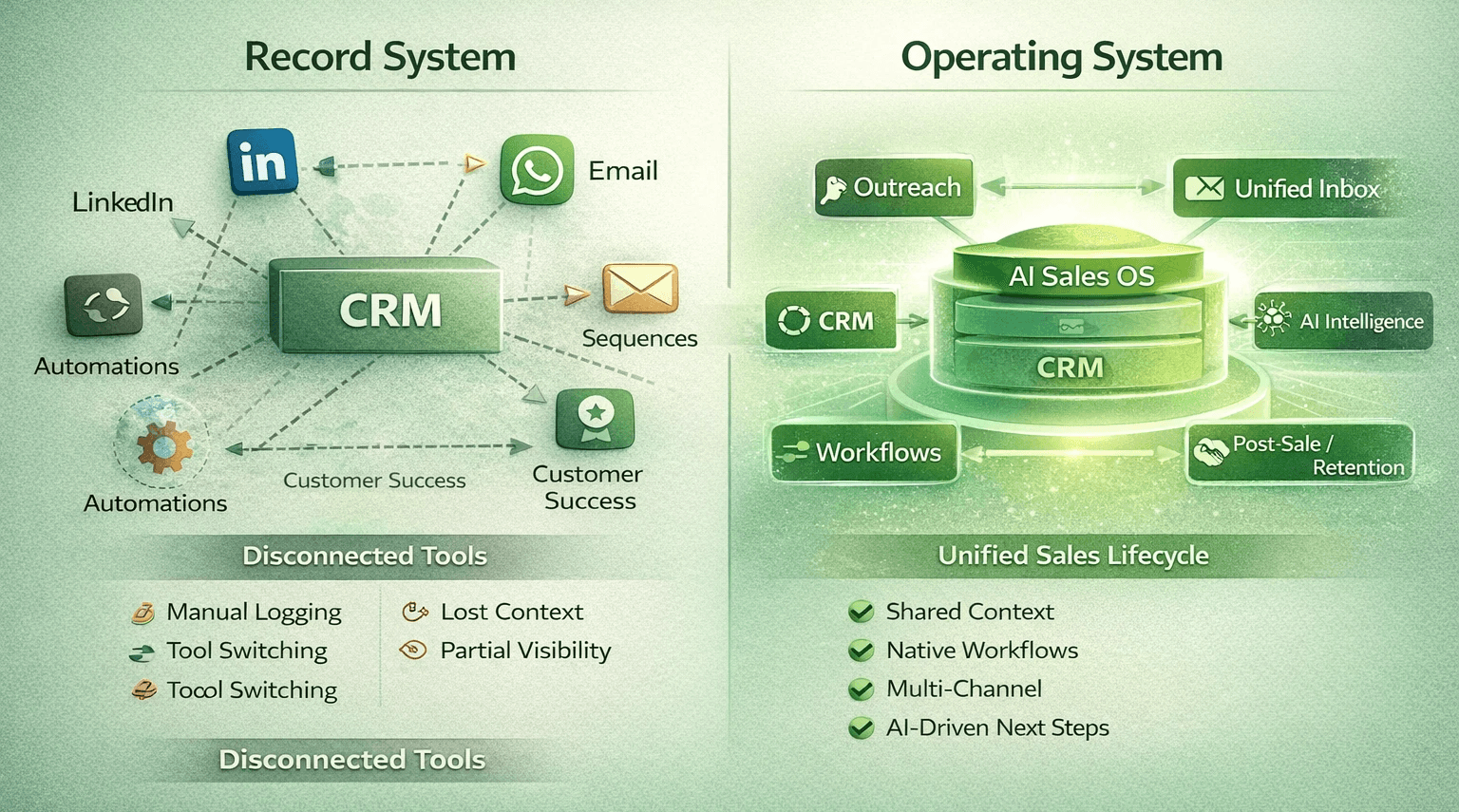
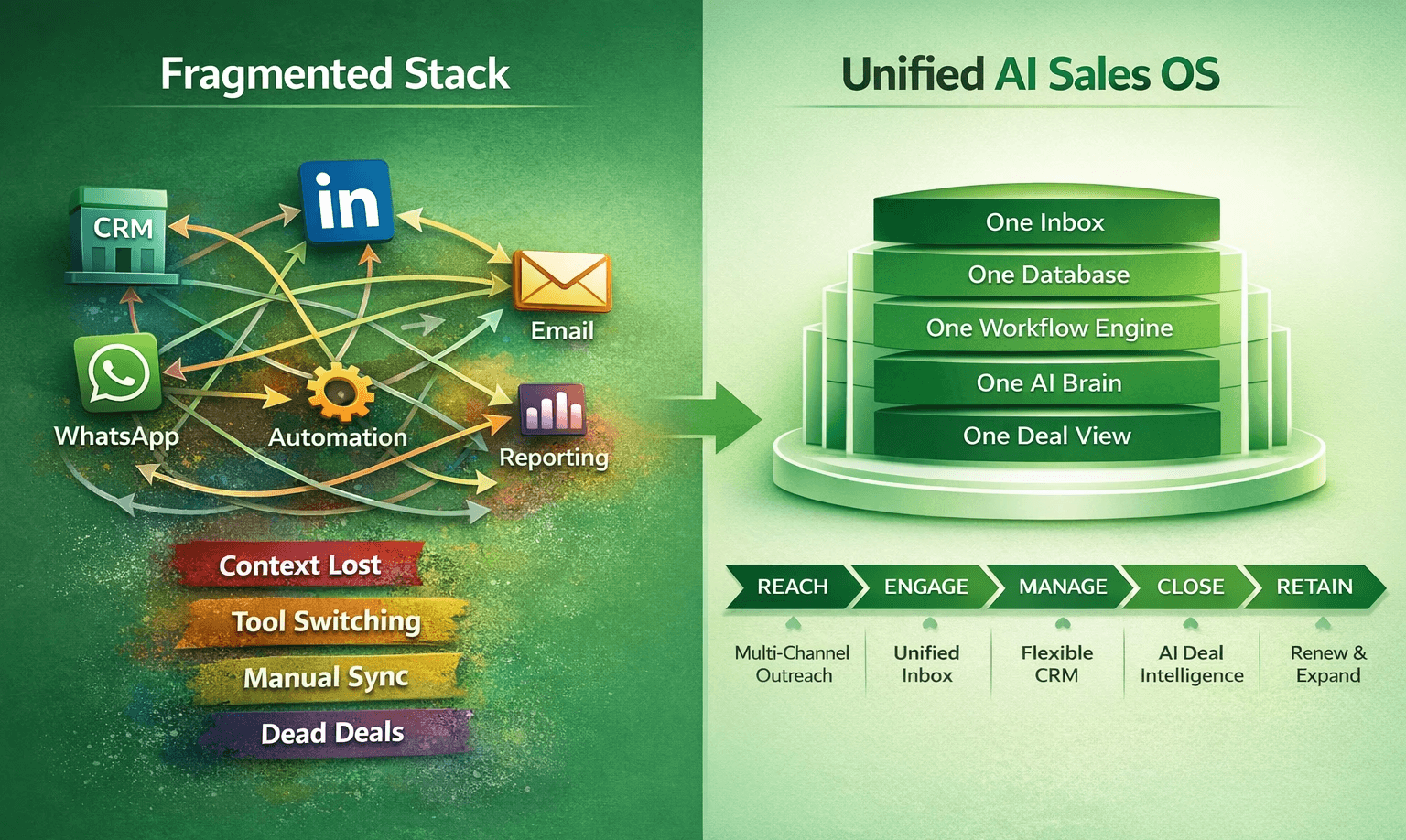
Why Dalil?
Back
Most popular
Dalil AI vs Attio: Which CRM actually closes deals in 2026?
Which one is built for how B2B sales actually happens in 2026.
Side-by-Side: Dalil AI vs Attio
Capability | Attio | Dalil AI |
|---|---|---|
CRM flexibility | ✅ Excellent — custom objects, relationships | ✅ Excellent — custom objects, relationships |
✅ Native Gmail/Outlook sync | ✅ Native Gmail/Outlook sync | |
❌ No integration | ✅ Native — messaging, sequences, unified inbox | |
❌ No native integration | ✅ Native — messaging, sequences, unified inbox | |
Multi-channel outreach automation | ❌ Email only, linear sequences | ✅ LinkedIn + WhatsApp + email from one canvas |
Outreach volume limits | ⚠️ Max 10 enrollments in sequences (reported) | ✅ Caps only suggested based on communication channels recommendation against account banning. |
AI | ✅ Ask Attio — CRM-aware, query-based | ✅ Deal intelligence across all channels — health scoring, sentiment, next-best-action ✅ CRM commands via WhatsApp — text, voice notes and pictures of business cards |
Unified inbox | ❌ Email only | ✅ LinkedIn + WhatsApp + Email in one feed |
Workflow automation | ✅ Full no-code automation engine | ✅ Full no-code automation engine |
Starting price (monthly billing) | $36/seat/mo (Plus) — sequences need Pro at $86 | |
Full stack cost to match Dalil | $254/seat/mo (Attio Pro + Lemlist + Surfe) | CRM+ Automations + outreach + one inbox — All in one platform |
Attio is one of the most beautiful CRMs ever built. Clean interface. Genuinely flexible data model. An AI assistant that knows your pipeline cold. If you care about how your CRM looks and feels, Attio will make you happy.
But there's a question Attio can't answer — and it's the most important one in B2B sales right now:
What happened in your last conversation with this prospect on LinkedIn? What did they say on WhatsApp yesterday?
Attio doesn't know. Because those conversations never happened inside Attio.
This comparison isn't about which tool has a nicer UI. It's about which one actually supports how B2B sales works in 2026 — where deals are won or lost across LinkedIn DMs, WhatsApp threads, and email chains, often in the same week.
What Attio Is (And What It Isn't)
Attio launched in 2021 with a clear and honest ambition: build the CRM that modern go-to-market teams actually want to use. No rigid Salesforce schema. No bloated HubSpot admin layer. Just a clean, Notion-style database that adapts to your process.
And they delivered on that promise. Attio is a highly customizable CRM built on a proprietary relational database model — you define your own objects, relationships, and views. We set up our first custom objects in under 15 minutes, and onboarding a new teammate takes less than an hour.
The AI layer is genuinely impressive. Ask Attio can field natural-language questions about your pipeline — "Which deals are stalling?", "Show me all contacts at Company X who haven't replied in 30 days" — and answer them with context drawn from everything in your CRM.
Attio's offering is now very robust and enterprise ready. The interface has modern design, reminds you of an Apple product. AI native features are built in an easy to use manner into core parts of the product.
So what's the problem?
The problem is where the data stops.
Attio knows your CRM. It doesn't know your LinkedIn. It doesn't know your WhatsApp. Attio doesn't connect with LinkedIn at all. And there's no deep LinkedIn integration — niche sales tools like Apollo and Lemlist have no native connectors either.
For teams whose deals live on those channels — which in 2026 means most B2B teams — that's not a gap. It's a wall.
The channel problem: Where B2B sales actually happens
Here's a realistic deal cycle for a modern B2B sales rep in 2026:
Connect on LinkedIn and exchange 3–4 DMs to qualify interest
Jump on a 15-minute intro call
Follow up on WhatsApp because the prospect responds faster there
Send the proposal by email
Close the loop on LinkedIn when they've gone quiet
Now ask yourself: where does each of those touchpoints live in Attio?
Steps 1, 3, and 5 don't exist in Attio at all. LinkedIn DMs and WhatsApp messages are invisible to the platform — unless a rep manually copies and pastes them into notes, which nobody actually does under real sales pressure.
The result is a CRM that has a beautiful view of your deals — but is missing 60% of the conversations that created them.
Attio's channel coverage
Channel | Attio |
|---|---|
✅ Native Gmail/Outlook sync | |
LinkedIn messaging | ❌ No integration |
❌ No native integration | |
Unified multi-channel inbox | ⚠️ Email only |
Attio Sequences aren't built for high-volume outbound or multi-channel cadences. There's no SMS, no dialer, and no A/B testing. Email sequences exist, but they're linear — don't expect branching logic or conditional paths.
Real users confirm it: "Due to system limitations, we cannot enrol more than 10 people in our email sequences at a time — that does not make any sense for an outreach tool."
Dalil AI's channel coverage
Dalil AI was built around the opposite assumption: that modern B2B sales is multi-channel by default, and your CRM needs to reflect that reality.
Channel | Dalil AI |
|---|---|
✅ Native (full threading, tracking) | |
LinkedIn messaging | ✅ Native (unified inbox, reply from CRM) |
✅ Native (messages, voice notes, CRM commands) | |
Unified multi-channel inbox | ✅ All channels, one feed, tied to the deal |
Every LinkedIn message, every WhatsApp reply, every email — all in one timeline, attached to the deal. Nothing copied. Nothing lost.
The outreach gap: CRM vs. Sales OS
Attio is a CRM. A genuinely excellent one. But CRMs store deals — they don't fill pipelines.
To actually prospect with Attio, you need outreach automation. And Attio doesn't have it.
No multi-channel orchestration — coordinating email, phone, LinkedIn, and chat touchpoints requires separate tools. Attio syncs email and offers AI context, but it lacks native cold outreach and multi-step sequencing. Teams usually pair it with a separate emailing tool.
That separate tool is usually Lemlist, which runs $109/month per seat. Add Surfe ($59/seat) to bridge LinkedIn data into Attio. Suddenly you're at $254/seat/month for a stack that still requires logging into three different products.
Component | Tool | Monthly Cost |
|---|---|---|
CRM + email sequences | Attio Pro | $86/seat/mo |
Multi-channel outreach | Lemlist Multichannel Expert | $128/sender/mo |
LinkedIn-CRM sync | Surfe Pro | $59/seat/mo |
Total | 3 tools, 3 logins, 3 invoices | $254+/seat/mo |
Dalil AI includes native multi-channel outreach automation — LinkedIn + WhatsApp + email sequences — inside the CRM itself. Not a third-party integration. Not a bridge tool. Built in.
The cost is at www.usedalil.ai. The stack is one platform.
The AI intelligence Gap: CRM context vs. Deal context
Both platforms have AI. But they're not the same kind of AI.
Ask Attio is impressive. It reads everything in your CRM — deal stages, contact records, notes, email threads — and answers natural language questions about your pipeline with real precision. For teams that want a smarter way to query their CRM data, Ask Attio is one of the best features in any CRM on the market.
The limitation isn't the AI. It's what the AI has access to.
Ask Attio can tell you where a deal is in your pipeline. It can surface contacts who haven't been touched in 60 days. It can summarize email threads. But it can't tell you the sentiment of a LinkedIn conversation from last week — because that conversation isn't in the platform.
Dalil AI's deal intelligence reads across all channels because all channels are native:
LinkedIn conversation with the prospect last Tuesday? In the deal.
WhatsApp message confirming they're still interested? In the deal.
Email with the proposal PDF? In the deal.
Because all three are in one place, the AI can score deal health based on real conversation patterns, not just CRM field updates. It can flag when sentiment is dropping. It can suggest the right next action based on what's actually been said — not just what stage the deal is in.
The result is the difference between CRM intelligence (Attio knows your pipeline) and deal intelligence (Dalil AI knows your deals).
Who Attio is actually built for
Let's be direct: Attio is an excellent product for specific use cases.
Attio resonates most with startups and scale-ups in rapid growth that need a CRM that evolves with them, venture capital and private equity firms that manage complex networks of founders, LPs, and deal flow, and modern go-to-market teams with unique processes who find traditional CRMs restrictive.
If your sales process is primarily email-based, you're managing complex relationship networks (VC, PE, partnerships), or you need a deeply flexible data model to track non-standard objects — Attio is genuinely one of the best choices available.
If you're a B2B sales team running active outbound across LinkedIn, WhatsApp, and email, trying to fill a pipeline and close deals with consistent context across every touchpoint — Attio will leave you assembling a tool stack that costs $254/seat/month and still loses context between tools.
The Real Question
Both tools have genuine strengths. Both are well-built. Both are used by smart sales teams.
The question isn't which CRM has better custom objects or a nicer interface. The question is: where are your deals actually happening?
If they're happening in LinkedIn DMs that never reach your CRM, WhatsApp threads that live in a separate app, and email replies that don't know about the LinkedIn conversation that preceded them — then the most beautiful CRM in the world can't save you.
Dalil AI is built for that reality. AI Sales OS isn't a marketing term — it's what happens when you stop treating LinkedIn, WhatsApp, and email as separate tools and start treating them as one system that knows everything about every deal.
From first outreach to closed deal — no context lost.
Start your 14-day free trial →
FAQ
Does Attio have LinkedIn integration? No. As of 2026, Attio has no native LinkedIn integration. It syncs Gmail and Outlook for email, but LinkedIn conversations are not captured in the platform. Teams that need LinkedIn in their CRM typically use a bridge tool like Surfe ($59/seat/month) alongside Attio.
Can Attio replace Lemlist? Not fully. Attio has email sequences through its workflow automation, but they're linear (no conditional branching), limited in enrollment volume, and email-only. To run multi-channel sequences across LinkedIn, WhatsApp, and email, you still need a dedicated outreach tool like Lemlist stacked on top of Attio.
What is Dalil AI? Dalil AI is an AI Sales OS — a single platform that combines a full CRM with native LinkedIn, WhatsApp, and email channels, integrated multi-channel outreach automation, flexible workflow automation, and AI deal intelligence. It replaces the CRM + outreach tool + LinkedIn bridge stack that most B2B teams are currently running.
How does Dalil AI's AI compare to Ask Attio? Ask Attio is impressive for querying CRM data — it knows your pipeline, deals, contacts, and email history. Dalil AI's deal intelligence reads CRM data AND LinkedIn and WhatsApp conversations, because all channels are native. This enables deal health scoring, sentiment analysis, and next-best-action coaching based on the full picture of each deal — not just what's been logged in the CRM.
Is Attio good for startups? Yes — Attio is genuinely excellent for early-stage startups that are primarily email-based, managing investor or partnership relationships, or need a highly flexible data model. It's less suited for outbound-heavy B2B sales teams whose prospects are on LinkedIn and WhatsApp.

Giuseppe Manzone

Co-founder and CEO
Giuseppe Manzone is a former McKinsey consultant and entrepreneur with more than 13 years of experience in sales strategy and operations. His mission it to build a system aiming to help teams simplify sales and grow faster.
Are you ready to convert more leads into customers?
Join 100+ agencies, startups & medium sized businesses closing deals with Dalil AI Sales OS
Latest posts
Discover other pieces of writing in our blog