AI Sales OS
Most popular
AI Sales OS vs CRM: Why a CRM Isn't Enough Anymore
See why teams are making the switch.
Your CRM is not the problem. It's doing exactly what it was designed to do — track contacts and manage pipeline stages. The problem is that selling in 2026 requires far more than contact tracking, and your CRM was never built to handle the rest.
An AI Sales OS (AI Sales Operating System) is a unified platform that covers the entire sales lifecycle — outreach, engagement, deal management, AI-driven intelligence, and post-sale retention — in a single system with shared context. A CRM is one layer of that system. An important layer, but just one.
This article breaks down exactly where a CRM stops and an AI Sales OS starts, why that gap matters more now than five years ago, and how to decide which one your team actually needs.
The CRM was built for a different era
CRMs trace their lineage back to the 1980s. ACT! launched in 1987 as a digital Rolodex. Siebel Systems brought enterprise sales tracking in the '90s. Salesforce moved it to the cloud in 1999. HubSpot made it free and accessible in 2014.
Each generation solved the problem of its decade. Contact storage. Pipeline visualization. Reporting. Forecasting.
But the way B2B teams sell has fundamentally changed since then:
Then (CRM era): One channel (email or phone). One rep per deal. Manual data entry was acceptable because there weren't many data sources. The CRM was the center of gravity because it was the only digital tool reps used.
Now (2026): Three to five channels per deal (LinkedIn, WhatsApp, email, phone, SMS). Multiple stakeholders. Automated sequences that generate hundreds of touchpoints per week. AI that can read sentiment and predict outcomes. The CRM is no longer the center — it's one node in a web of disconnected tools.
The CRM category hasn't kept pace with this shift. It's been extended — plugins, add-ons, marketplace integrations — but at its core, it remains what it was in 1999: a database of contacts and a pipeline board.
An AI Sales OS starts from a different premise: what if the entire sales operation lived in one system, with AI woven through every stage?
The five blind spots every CRM has
A CRM can only act on information it has. The structural problem is that most of the information driving modern sales happens outside the CRM. These blind spots aren't bugs — they're architectural limitations of a system designed before multi-channel selling existed.
Blind spot #1: Outreach context
Your CRM knows a contact exists. It might know their company, title, and last activity date. But it doesn't know:
Which sequence they received
Which channel triggered their first reply
How many touchpoints it took to get engagement
What messaging angle resonated
That context lives in your outreach tool (Lemlist, Instantly, Apollo). When a deal moves to the CRM, the outreach history stays behind. The rep managing the deal doesn't know what got the prospect interested in the first place.
Blind spot #2: Channel conversations
A prospect sends a LinkedIn voice message saying they're interested but need budget approval. They follow up via WhatsApp two days later with a question about pricing. They CC their CFO on an email thread the next week.
Your CRM sees none of this — unless a rep manually logs each interaction. And we both know how often that happens. Studies consistently show reps spend less than 30% of their time actually selling, with the rest consumed by admin tasks like CRM data entry.
An AI Sales OS captures conversations across LinkedIn, WhatsApp, and email natively. No manual logging. No lost threads.
Blind spot #3: Automation state
If you're using Zapier or Make to connect your outreach tool to your CRM, your CRM doesn't understand the automation — it just receives the output. It doesn't know:
Whether an automation failed silently
If a prospect is mid-sequence or completed
What conditions triggered a workflow
Whether two automations are contradicting each other
In an AI Sales OS, automations are native. The system doesn't need middleware because every workflow runs inside the same platform that manages your deals and conversations.
Blind spot #4: Conversation sentiment
Your CRM tracks deal stages. "Discovery → Proposal → Negotiation → Closed Won."
But deal stages don't tell you how the conversation feels. A deal in "Negotiation" could mean the buyer is excited and finalizing budget, or it could mean they've gone quiet and you're hoping for a reply.
AI deal intelligence reads the actual conversations — email tone, WhatsApp response speed, LinkedIn engagement patterns — and translates them into signals: deal health scores, risk alerts, and next-best-action recommendations. A CRM doesn't have access to the conversation data needed to do this.
Blind spot #5: Post-sale continuity
When a deal closes in your CRM, the relationship effectively restarts. The customer success team gets a handoff document (maybe), but the rich context of how the deal was won — the pain points discussed, the objections raised, the champion's priorities — lives fragmented across tools the CSM doesn't have access to.
An AI Sales OS keeps the full thread. Same platform, same conversation history, same context. The CSM sees everything the sales rep saw, from the first outreach to the signed contract.
What an AI Sales OS actually does differently
The difference isn't features. It's architecture.
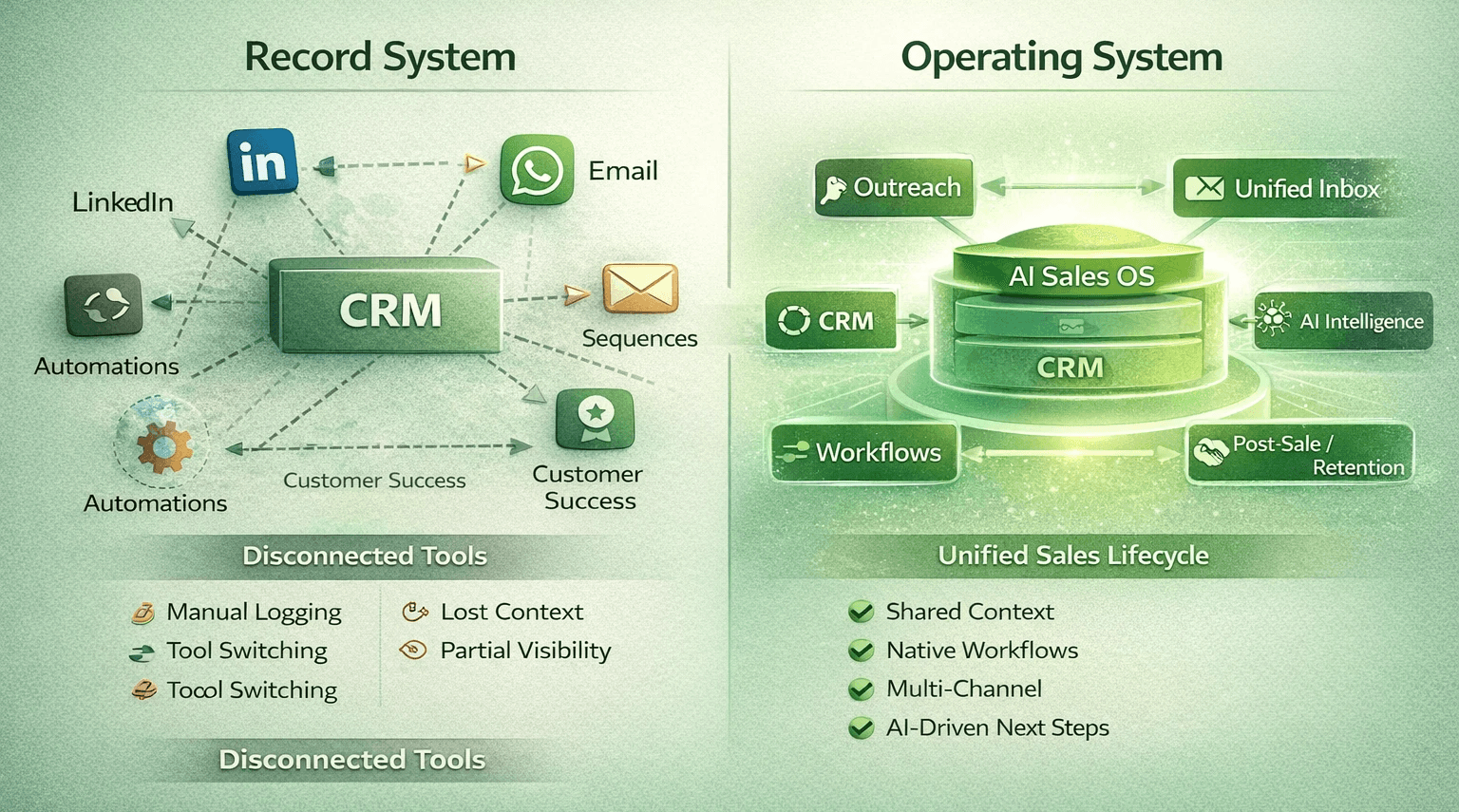
A CRM is a record system — it stores what happened. An AI Sales OS is an operating system — it orchestrates what happens next.
Here's what that means in practice:
Native multi-channel execution. An AI Sales OS doesn't need a separate tool for LinkedIn outreach, another for email sequences, and another for WhatsApp. All channels are native. One sequence can span LinkedIn → email → WhatsApp with conditional logic, and the system tracks every interaction automatically.
Unified context across stages. When a prospect moves from outreach to active deal, nothing is lost. The rep sees the full history: which sequence brought them in, which message they replied to, every conversation across every channel, and the AI's assessment of their engagement level.
AI that understands the full picture. Because the AI has access to conversations, sequences, deal data, and engagement patterns — all in one system — it can do things a bolt-on AI tool never could: predict deal health based on cross-channel sentiment, suggest the right channel for the next touchpoint, and flag risks before they become lost deals.
Workflow automation without middleware. Trigger-based automations run natively. "When a prospect replies on WhatsApp, move the deal to Discovery and notify the account owner" doesn't need Zapier. It's built in.
For a deeper look at how these capabilities map to the full sales lifecycle, see our complete guide to the AI Sales OS category.
When a CRM is still enough
Not every team needs an AI Sales OS. Here's a practical framework:
A CRM is probably enough if:
Your team sells primarily through one channel (inbound email, for example)
You have fewer than 3 reps and manage deals manually
Your sales cycle is short (under 2 weeks) with few touchpoints
You don't run automated outreach sequences
Your post-sale process is handled by a separate team with its own tools — and that's working fine
You've outgrown your CRM if:
You're running outreach across LinkedIn, email, and WhatsApp — and using separate tools for each
Reps spend meaningful time logging activities manually instead of selling
You've built Zapier automations to connect your CRM to your outreach and sequence tools
Your pipeline forecast feels unreliable because deal stages don't reflect reality
Context breaks when deals move between teams or tools — sales to CS handoffs are painful
You're paying for 3+ tools that each handle one piece of the sales process
If three or more items in the second list describe your team, a CRM is no longer your operating system — it's one piece of a fragmented stack. And the gap between what your CRM does and what your team needs is filled with duct tape, manual work, and lost context.
The cost of staying in CRM-only mode
Teams that stay in CRM-only mode don't just miss features. They accumulate hidden costs that compound over time:
Time cost. Reps toggle between 4–5 tools daily. The American Psychological Association's research on task switching suggests a 20–40% productivity loss when context-switching frequently. For a sales rep, that's 60–90 minutes per day lost to tool navigation, not selling.
Data cost. Every tool boundary is a place where data can be lost, delayed, or duplicated. If your Zapier automation fails at 2 AM, your CRM doesn't know about the LinkedIn conversation that happened yesterday. Nobody notices until the deal is cold.
Deal cost. When reps don't have full context, they make suboptimal moves. They send the wrong follow-up on the wrong channel. They miss buying signals buried in a WhatsApp thread their CRM can't see. Sales teams spend $200+/user/month on disconnected tools, and still lose deals to context gaps.
Scaling cost. Every new rep you onboard needs access to 4–5 tools, training on each, and an understanding of how data flows between them. An AI Sales OS simplifies onboarding to one platform with one workflow.
Making the switch: CRM to AI Sales OS
If you've decided your team has outgrown its CRM, the transition doesn't have to be dramatic. An AI Sales OS like Dalil AI replaces the CRM and the outreach tool and the automation layer — so migration is actually a consolidation.
What changes:
Your pipeline moves into the AI Sales OS (same concept, more flexible structure)
Your sequences move in too (native multi-channel, no separate tool)
Your automations move in (native workflows, no Zapier)
Your conversations are captured automatically (LinkedIn, WhatsApp, email — all native)
What stays the same:
Your sales process (the AI Sales OS adapts to it, not the other way around)
Your rep's daily workflow (reach out, engage, manage deals, close — just in one place now)
The net result: fewer tools, lower cost, better context, and AI that actually understands your deals because it has access to all the data — not just the CRM fragment.
Start your 14-day free trial →
Frequently Asked Questions
Can an AI Sales OS import my existing CRM data?
Yes. An AI Sales OS like Dalil AI can import contacts, deals, and pipeline data from your existing CRM. The difference is that once imported, your data lives alongside conversation history, sequence data, and AI insights — all in one platform instead of scattered across tools.
Is an AI Sales OS more expensive than a CRM?
On its own, it costs more than a standalone CRM. But it replaces your CRM plus your outreach tool, LinkedIn automation, and workflow automation platform. When you compare the total stack cost, an AI Sales OS typically saves teams 40–60% while giving them more capability.
What if I only sell through one channel, do I still need an AI Sales OS?
If you sell exclusively through one channel with a simple process, a CRM may be sufficient. But most B2B teams engage prospects across at least two channels (email + LinkedIn is the minimum for most outbound teams), and that's where CRM limitations start showing.
How is an AI Sales OS different from a CRM with AI features?
Some CRMs have added AI bolt-ons — chatbots, basic lead scoring, email suggestions. But these features operate on CRM data only. An AI Sales OS has AI woven through the full lifecycle: it reads conversations across all channels, scores deals based on multi-channel engagement, and suggests next actions based on patterns a CRM-only AI never sees.
Does switching mean my team needs to learn an entirely new system?
The core concepts are the same — contacts, deals, pipelines, activities. The difference is that everything your team currently does across 3–5 tools now happens in one place. Most teams find it simplifies their workflow rather than complicating it. Dalil AI is designed to adapt to your process, not force you into a new one.


Are you ready to convert more leads into customers?
Join 100+ agencies, startups & medium sized businesses closing deals with Dalil AI Sales OS
Latest posts
Discover other pieces of writing in our blog